KeyForge AI
Non-Human Identity Governance

Govern the identities that outnumber your people.

Service accounts, API keys, certificates and workload identities are provisioned by projects, inherited by teams and rarely reviewed — yet they hold real transactional authority. Discover them, give each an owner, and assure them continuously.

Questions this answers

Where most NHI programmes start

Capabilities

From discovery to continuous certification

01 · Discovery

Inventory relentlessly

Aggregate from directories, cloud IAM, vaults, CI/CD and application service-account tables. Deduplicate by credential, not by name.
02 · Ownership

A named human for every identity

Every account gets an owner and a purpose. Unowned accounts follow a defined path: restrict, observe, retire.
03 · Lifecycle

Creation to retirement, under policy

Created through an approved path with an owner and an expiry, rotated on schedule, deactivated when the owning system ends.
04 · Risk classification

Granted against used

Granted scope compared with actual usage and with peers, surfacing the over-privileged tail and the toxic combinations no human holds.
05 · Certificates & service accounts

Credentials as identities

Whoever can read the secret is effectively that account — so governance tracks who can use a credential, not just where it is stored.
06 · Privileged access orchestration

Vaulted, brokered, time-bound

Privileged machine credentials held in the vault you already run, with elevation and rotation orchestrated through policy.
07 · Continuous certification

Context, not calendars

Re-evaluated when the owner leaves, the credential appears somewhere new, or the usage pattern shifts — alongside the people who work beside them.

Coverage

Inventoried where they actually live

Each identity gets a named owner, a scope, a rotation schedule and an expiry — then enters the same governance as the people who work beside it.

Oracle EBS

What we inventory

Schema and database accounts, concurrent-program owners, SOA and middleware integration users, and shared administrative logins created during implementation.
Oracle Fusion

What we inventory

Web-service and FBDI/HDL loader accounts, integration cloud connection identities, and users carrying integration roles that quietly hold transactional privileges.
Workday

What we inventory

Integration System Users and the security groups behind them — frequently granted domain access far wider than the integration actually calls.
Service accounts
API keys
Certificates and internal PKI
Workload identities
AI agent credentials
Vaulted privileged credentials
An integration account that can both create a supplier and release a payment is a toxic combination with no human attached. Cross-application segregation of duties applies to non-human identities exactly as it does to people.

In the product

Findings routed to an owner

Unowned, over-privileged and stale machine identities surface as findings with severity, SLA and the reviewer they were routed to.
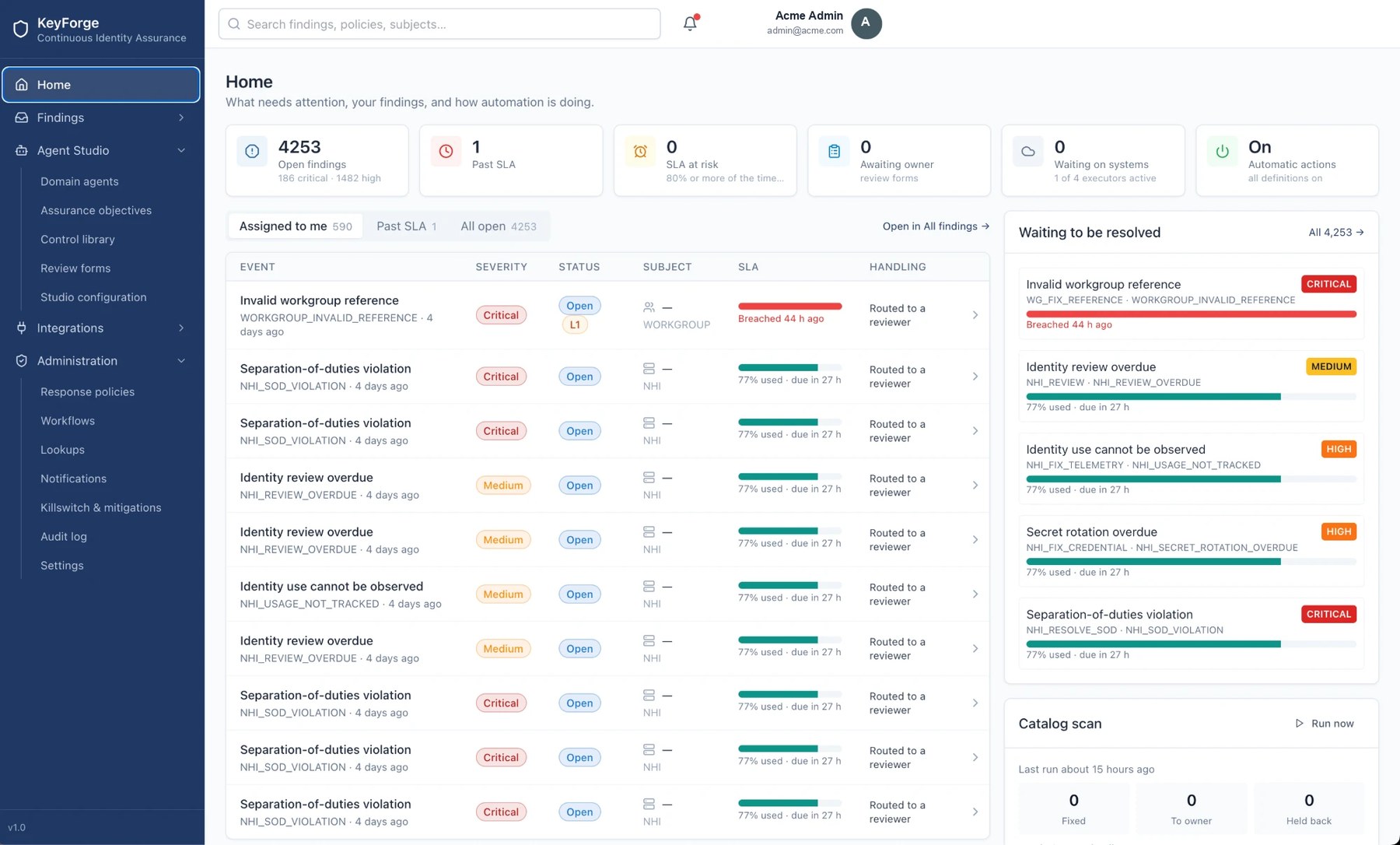
Findings dashboard showing open findings by severity, SLA progress and routing to reviewers
Findings — severity, SLA burn-down and routing

The portfolio

Built on the same foundation

Can you list every integration account with a named owner?

A read-only assessment returns that list for your estate.