KeyForge AI
Application Access Governance

Understand and govern what users can actually do across enterprise applications.

Go beyond role assignments with fine-grained entitlement visibility, privilege-level SoD analysis, application-specific authorization context, preventive risk simulation, and continuous access assurance across complex enterprise systems.

Capabilities

Six capabilities, one access model

Segregation of duties is one use of the model, not the whole of it. The same resolved view of access answers who can do what, through which grant, within which organisational scope.

01 · Fine-grained SoD

Down to the privilege

Analysis at the SAP authorization object, field and value, the Oracle Fusion privilege and the EBS form function — rather than at the role name an administrator happened to assign.
02 · Cross-application SoD

Conflicts that span systems

Toxic combinations across ERP, cloud, directory and enterprise applications, evaluated as one rule because each platform's access is normalised to the same model first.
03 · Effective access analysis

What a user can really reach

Role inheritance and nested permissions resolved to effective access, with the full path from user to privilege. Where access arrives through several routes, every route is shown.
04 · Data-level access context

Scope inside the rule

SAP company code and plant, Oracle business unit and ledger, EBS operating unit. A conflict counts only when both sides land in scopes the user could act on together.
05 · Preventive risk analysis

Simulate before you provision

Model a new role, an access request or a new hire before anything is granted, and see the projected conflicts and the change in risk before it becomes a finding.
06 · Remediation & controls

Evidence-backed remediation

Mitigating controls with owners, test frequency and expiry; role redesign informed by the roles generating the most conflicts; and remediation lists backed by privilege-level evidence.
Rules people can read

Stated in plain language, scored and scoped

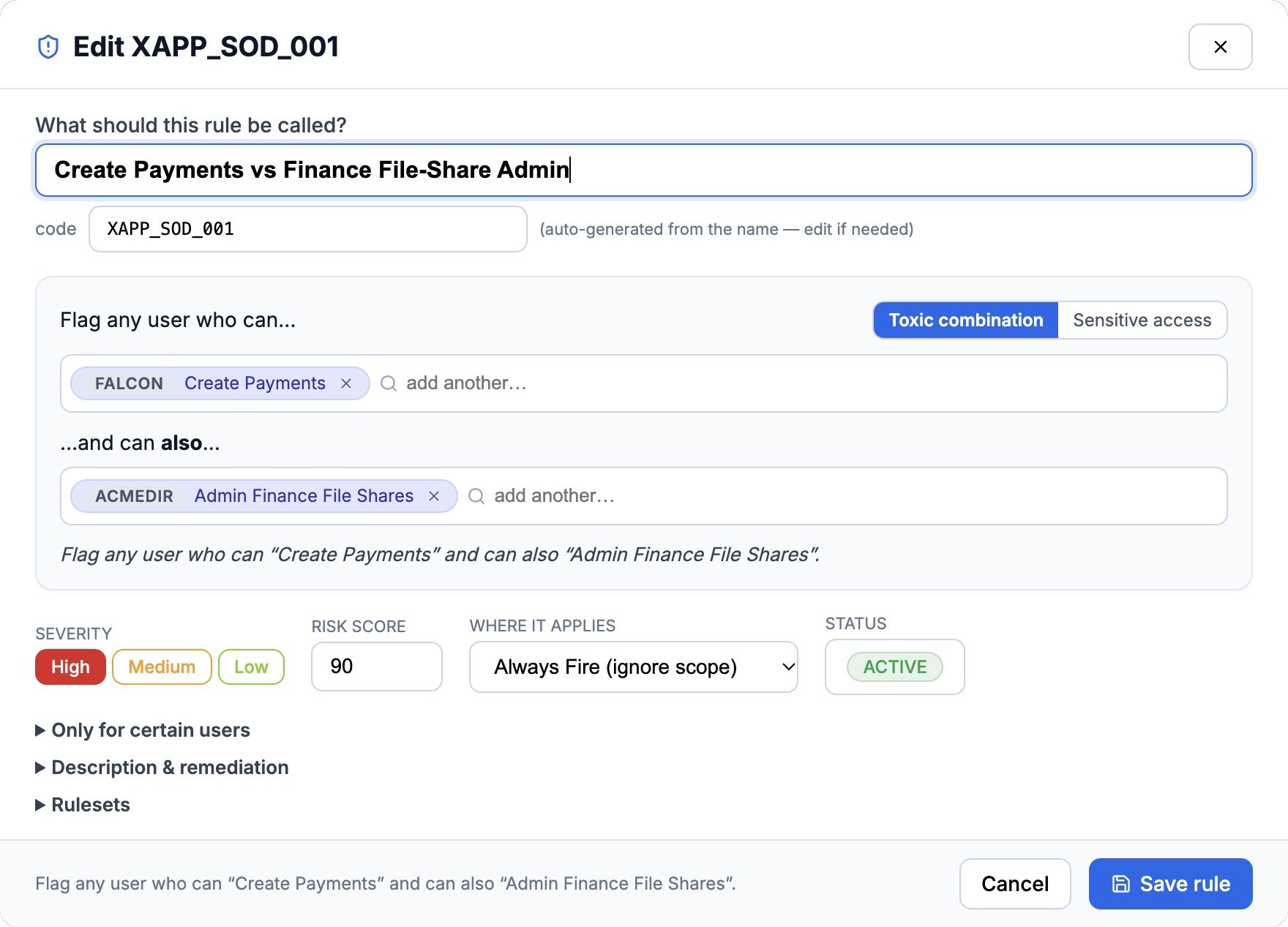
Create Payments lives in the ERP. Finance file-share administration lives in the directory. Each was approved by a different team. One rule spans both — and says so in a sentence a business owner can review.

Rule builder defining a cross-application toxic combination between an ERP payment function and directory file-share administration, with severity, risk score and scope
Rule definition — toxic combination across an ERP and a directory

Fine-grained evidence

Both sides, down to the privilege

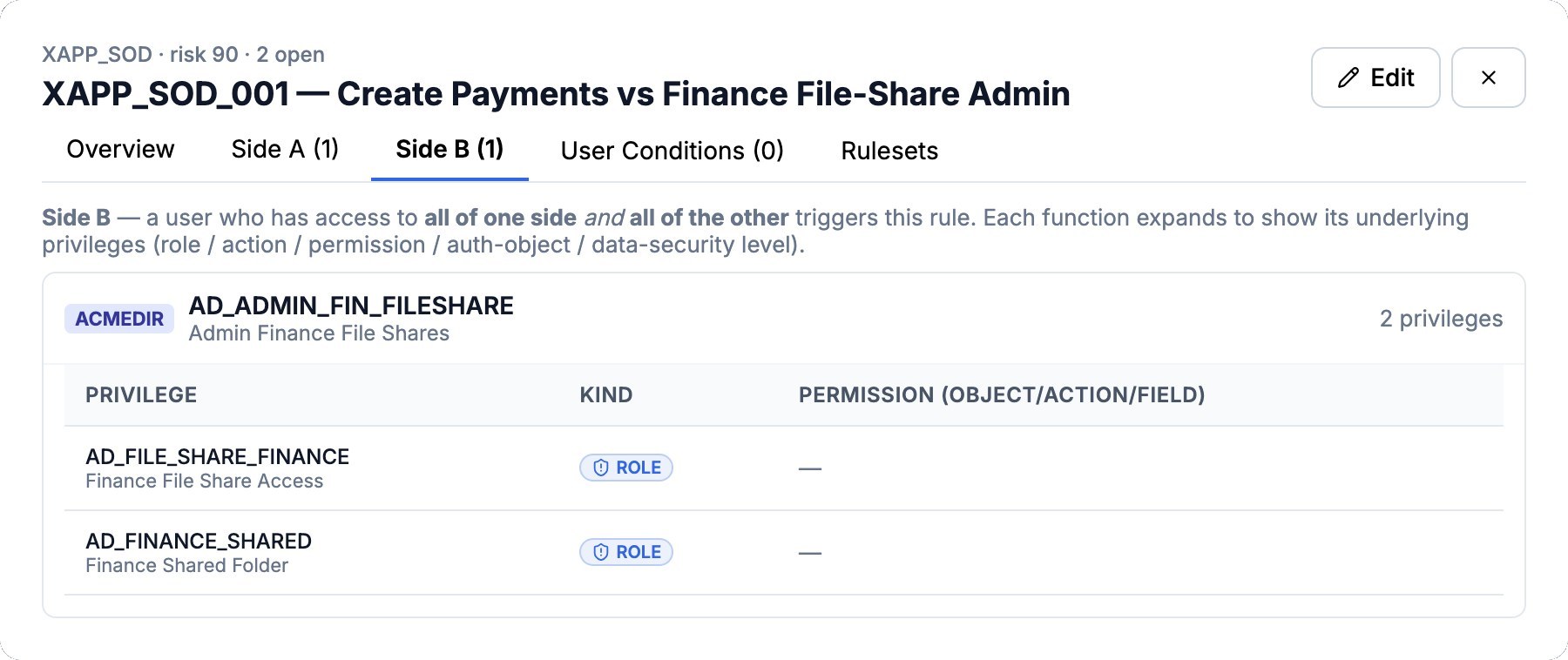
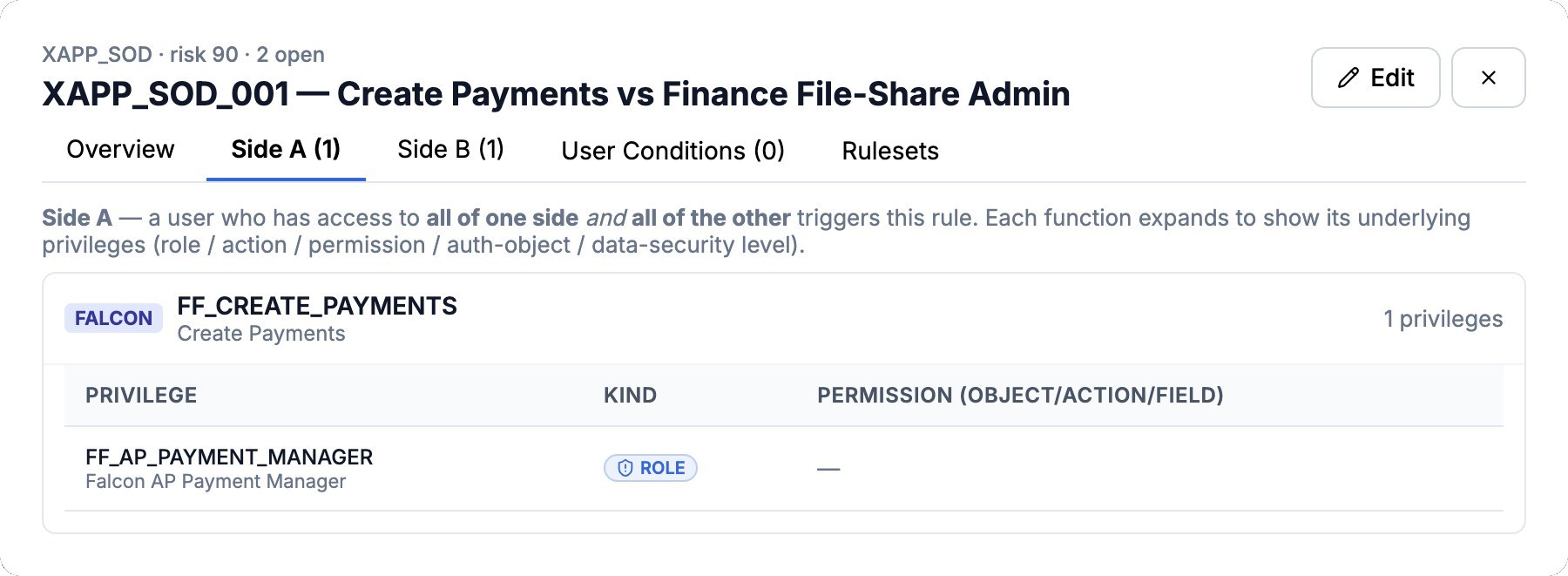
Each side of a rule expands to the grants underneath it — role, action, permission, authorization object or data-security level — so a reviewer sees exactly what makes the combination toxic.

Side A of a rule: an ERP payment function and the payment manager role that grants it
Side A — ERP function and its privileges
Side B of a rule: directory finance file-share administration and the two roles that grant it
Side B — directory grants and their privileges

Data-level context

How each platform actually grants access

Rules evaluate the effective permission after inheritance and nesting are resolved, together with the organisational dimension each platform uses to restrict it.

PlatformAccess is granted byResolved toData dimension
SAPSingle and composite roleAuthorization object, field and valueCompany code, plant
Oracle FusionJob and abstract roleDuty role, then privilegeBusiness unit, ledger
Oracle EBSResponsibilityMenu and form functionOperating unit
SailPointRole and entitlement modelApplication entitlementAs modelled
Microsoft EntraDirectory role and groupRole assignment and group membershipAdministrative unit
CyberArkSafe and account permissionVaulted credential accessSafe scope
Scope is evaluated inside the rule, not applied as a report filter afterwards. A same-unit rule fires only when both sides land in one operating unit — so the violation count you hand an auditor is a count the user could actually have acted on.

At scale

A rule library, not a blank page

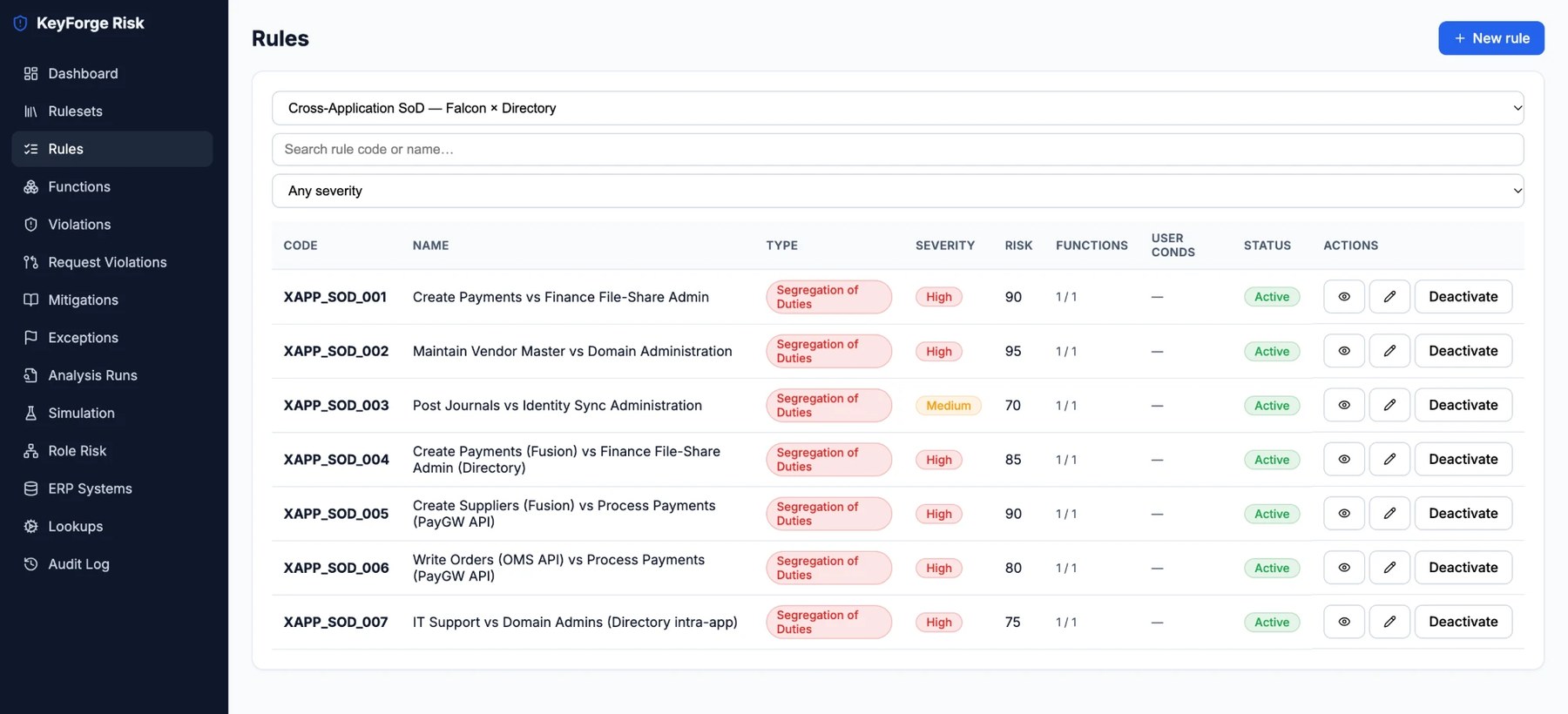
Content spans Financials, Human Capital, Procurement and Order-to-Cash, so a first meaningful risk picture arrives in days. Your own matrix loads from a spreadsheet, and any ruleset exports for review.

Cross-application segregation of duties ruleset listing active rules spanning ERP, directory and API systems with severity and risk scores
Cross-application ruleset — ERP × directory × API, each scored and scoped

Go deeper

Capability guides and briefs

Humans · machines · AI agents

The same rules for people, machines and agents

People

Privilege-level and cross-application SoD across the roles, responsibilities and groups people hold in each application.

Non-human identities

Integration and service accounts that can both create a supplier and release a payment — toxic combinations with no human attached.

NHI security
AI agents

Conflicts an AI agent assembles across the MCP tools it has been granted, even when each tool looked reasonable on its own.

Agentic AI security

The portfolio

Built on the same foundation

How many of your conflicts span two systems?

A read-only assessment returns a privilege-level, cross-application risk picture of your estate.