KeyForge AI
Continuous Identity Assurance

From periodic access reviews to continuous identity assurance.

Continuously detect changing identity risk, trigger targeted governance when it matters, orchestrate remediation and produce audit-ready evidence — without waiting for the next campaign.

Signals

What starts an assurance cycle

Access that was right when it was granted does not stay right. These are the changes that re-open the question.

Lifecycle changes

Transfers, terminations, contract extensions and sponsorship changes.

Entitlement events

Grants, role changes and privilege drift in the target systems.

Usage

Dormant entitlements and access that has never been exercised.

Peer analysis

Access that sets a user apart from colleagues in the same role.

Security findings

Alerts and posture findings from the security tools you already run.

Policy changes

A new or tightened rule re-evaluates the access it now applies to.

How it works

Signals in. Evidence out.

  1. 1

    Signal

    A lifecycle, entitlement, usage, security or policy event arrives.

  2. 2

    Reasoning

    Risk, peers, blast radius and policy evaluated against a versioned rule.

  3. 3

    Decision

    Revoke, approve with mitigation, accept risk or dismiss — by policy or by a reviewer.

  4. 4

    Remediation

    Executed against the target system and verified.

  5. 5

    Evidence

    Every transition retained as an immutable, reproducible record.

The reasoning step is Continuous Identity Reasoning — deterministic rules first, so every outcome traces to a named policy a reviewer and an auditor can both follow.

Capabilities

Seven capabilities, one cycle

01

Event-based detection

Risk is evaluated when something changes, not when the next campaign is scheduled.
02

Risk scoring

Each finding carries severity, blast radius and the evidence behind the score.
03

Targeted micro-certifications

One decision, sent to one reviewer, about the access that changed — instead of a quarterly spreadsheet.
04

Reviewer routing

Routed to the manager, application owner or control owner best placed to decide, with an SLA.
05

Compensating controls

Accepted risk is recorded with a mitigating control, an owner, a test frequency and an expiry.
06

Automated remediation

Revocations executed against the target system — automatically, or after the reviewer confirms.
07

Immutable evidence

Every transition from detection to closure is written to an audit record that can be replayed.
Related

Access reviews & micro-certifications

How targeted reviews replace rubber-stamped campaigns.
Learn more

Identity risk & posture analytics

Identity security posture, measured continuously

Dormant privilege, orphaned and unowned accounts, standing administrative access, toxic combinations and stale certifications — tracked as posture across the estate, ranked by consequence, and routed to an owner.
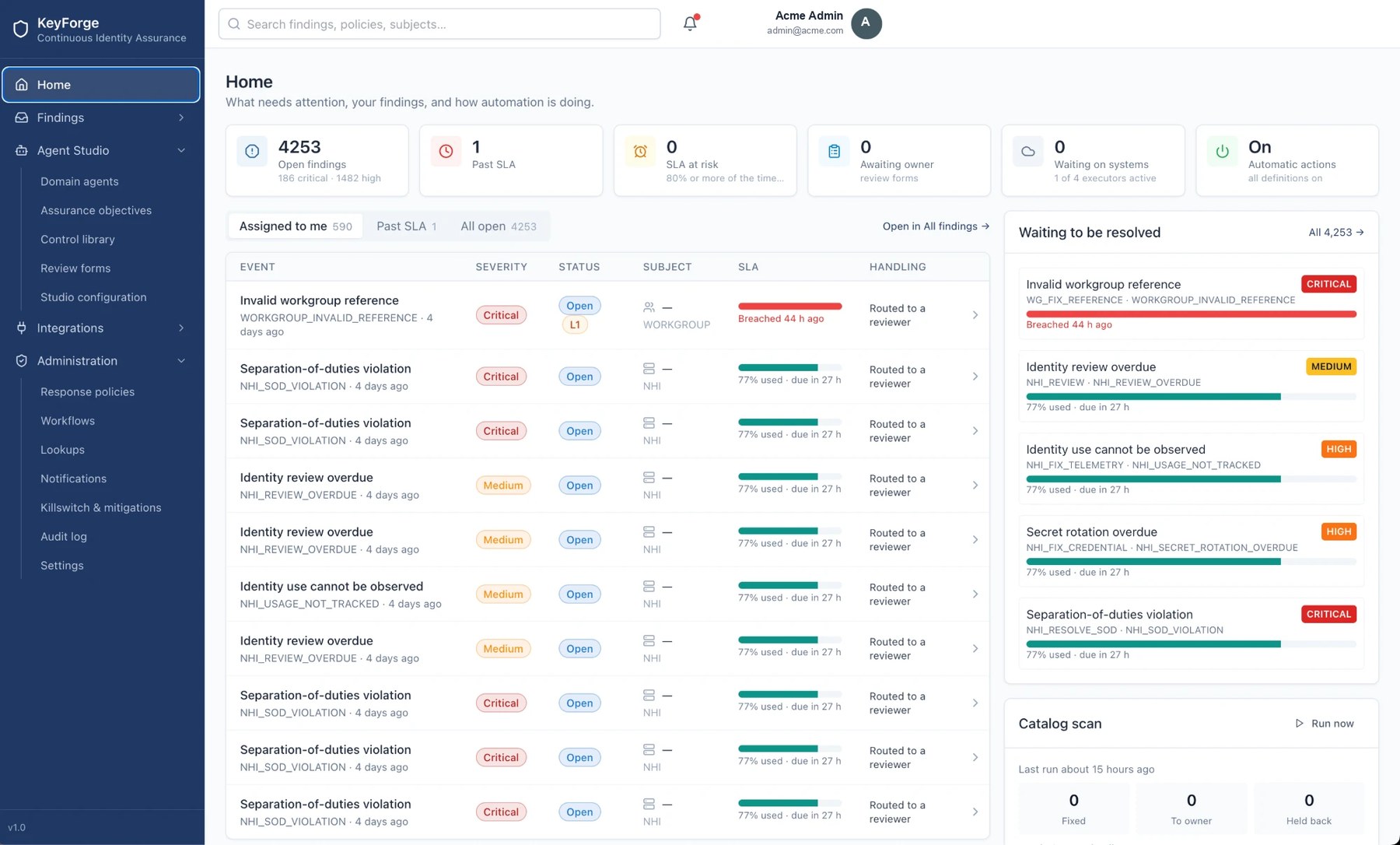
Findings dashboard showing open findings by severity, SLA progress and routing to reviewers
Findings — severity, SLA burn-down and routing

Detection coverage

Signal families, and what is live today

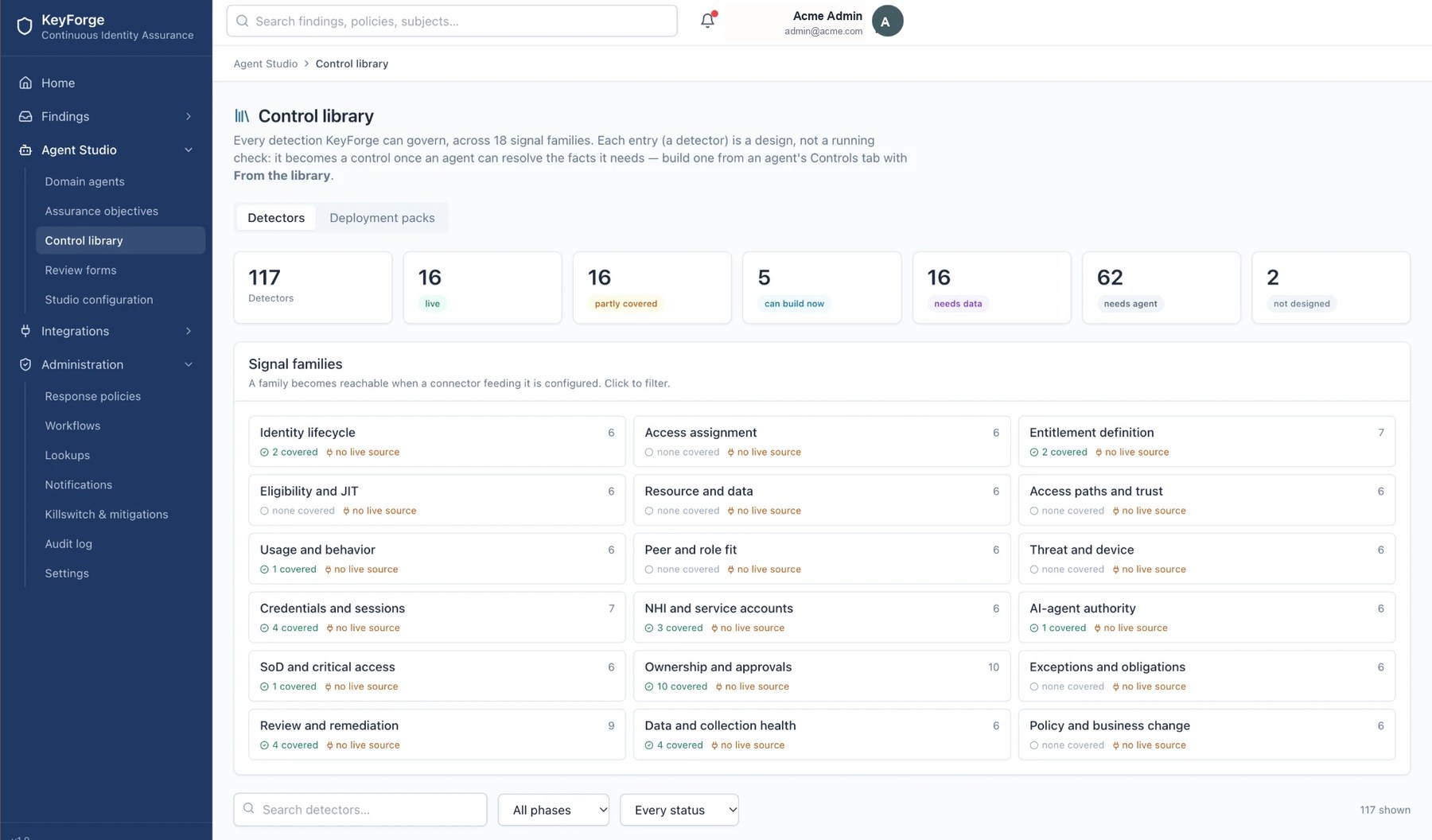
A detector becomes a control once an agent can resolve the facts it needs. The library states plainly which families are covered and which still need a connector — so coverage is a fact, not a claim.

Control library showing detectors grouped into signal families with coverage status
Control library — signal families and live coverage

Adoption

On top of the IGA you already run

Continuous Identity Assurance can be adopted on top of SailPoint, Saviynt or Oracle IGA without replacing provisioning. Your IGA keeps moving access; KeyForge AI continuously evaluates it, triggers targeted governance and records the evidence — or runs the whole cycle as part of KeyForge AI Identity Governance.

Humans · machines · AI agents

Assurance that covers machines and agents too

People

Transfers, terminations, dormant entitlements and peer outliers re-open the access decision as they happen.

Non-human identities

An owner leaves, a credential appears somewhere new, a rotation is missed or usage shifts — each triggers a targeted review of the non-human identity.

NHI security
AI agents

MCP server drift, expiring delegations and refused tool calls from supported integrations raise governed events with an owner and evidence.

Agentic AI security

The portfolio

Built on the same foundation

What is your current revocation rate?

See how continuous assurance changes it — against your own entitlement data.