KeyForge AI
Architecture

Continuous Identity Reasoning.

We define reasoning the way computer science does: the systematic evaluation of multiple signals to reach a defensible conclusion. Three tiers, each independently deployable, each fully transparent.

The engine

Three tiers. You choose where to stop.

Regulated buyers can run Tier 1 alone and get a complete, fully deterministic engine with no generative AI anywhere in the decision path. Innovation-led organisations can run all three.

Tier 01 · Required

Deterministic reasoning

Rule-based evaluation of metadata at every decision point. If an entitlement is privileged and the requester is a contractor whose contract expires within 30 days, route to a compliance approver and set expiry to the contract end date. Every outcome traces to a named rule. Zero opacity.
Tier 02 · Recommended

Statistical reasoning

Peer access analysis, role mining, outlier detection and usage-based right-sizing. Classical machine learning — clustering, classification, regression — industry-standard in IGA for a decade, and explainable through feature importance.
Tier 03 · Opt-in

Generative reasoning

LLM-assisted policy authoring, natural-language access requests, agent intent analysis and conversational audit explanation. Off by default, architecturally isolated, and never inserted into the decision path without explicit configuration.
Can we prove no LLM touched a decision? Yes. Tier 3 is architecturally isolated. When it is disabled, no generative component exists in the decision path — and the evidence trail shows it. Tiers can also be enabled per governance surface.

The lifecycle

Signals in. Evidence out.

Detection feeds the platform; the platform owns the policy, workflow, decision, mitigation and remediation model that follows.

  1. 1

    Signals

    Detection

    Entitlement, HR, usage and runtime events from the systems you already run.

  2. 2

    Reasoning

    Policy

    A versioned rule evaluates risk, peers, blast radius, scope and context together.

  3. 3

    Decision

    Judgement

    Revoke, approve with mitigation, accept risk or dismiss — signed and non-repudiable.

  4. 4

    Remediation

    Action

    Executed against the target connector automatically or by a reviewer, with rollback.

  5. 5

    Evidence

    Assurance

    Every state transition written to an immutable, reproducible audit record.

Event state moves OPEN → IN_REVIEW → DECIDED → MITIGATING → REMEDIATING → CLOSED, with SUPPRESSED, MERGED and EXPIRED as terminal branches. Transitions are enforced server-side; reviewers cannot skip states, and every transition writes an audit record.

The policy model

Versioned policy, not ad-hoc rules

Definition

The durable contract

A versioned definition owns the event type, severity, scope, criteria, reviewer resolution, SLA, escalation chain and the action applied if nobody responds. Active definitions are immutable — edits create a new version.
Reviewer resolution

Who decides, computed

Explicit user, role, manager-of-subject, application owner, data owner, entitlement owner, or a chain. Resolved when the event is created, and reassignable.
Escalation

Silence is not a decision

Nudge at 50% of SLA, manager at 80%, CISO at 100% — and a defined default action on timeout: auto-revoke, escalate, quarantine or accept.
Mitigations

A whitelist, not a free text box

Step-up MFA, time-bound access, peer review, session recording, JIT elevation, IP restriction or read-only downgrade — only those the definition permits.
Auto-remediation

Bounded by policy

What the system may execute without human approval, and the conditions under which it is allowed. Every action carries a rollback token.
Evidence requirements

Enforced at decision time

Mandatory fields — ticket link, business justification, compensating control reference — so an approval cannot be recorded without the basis for it.
Deterministic in practice

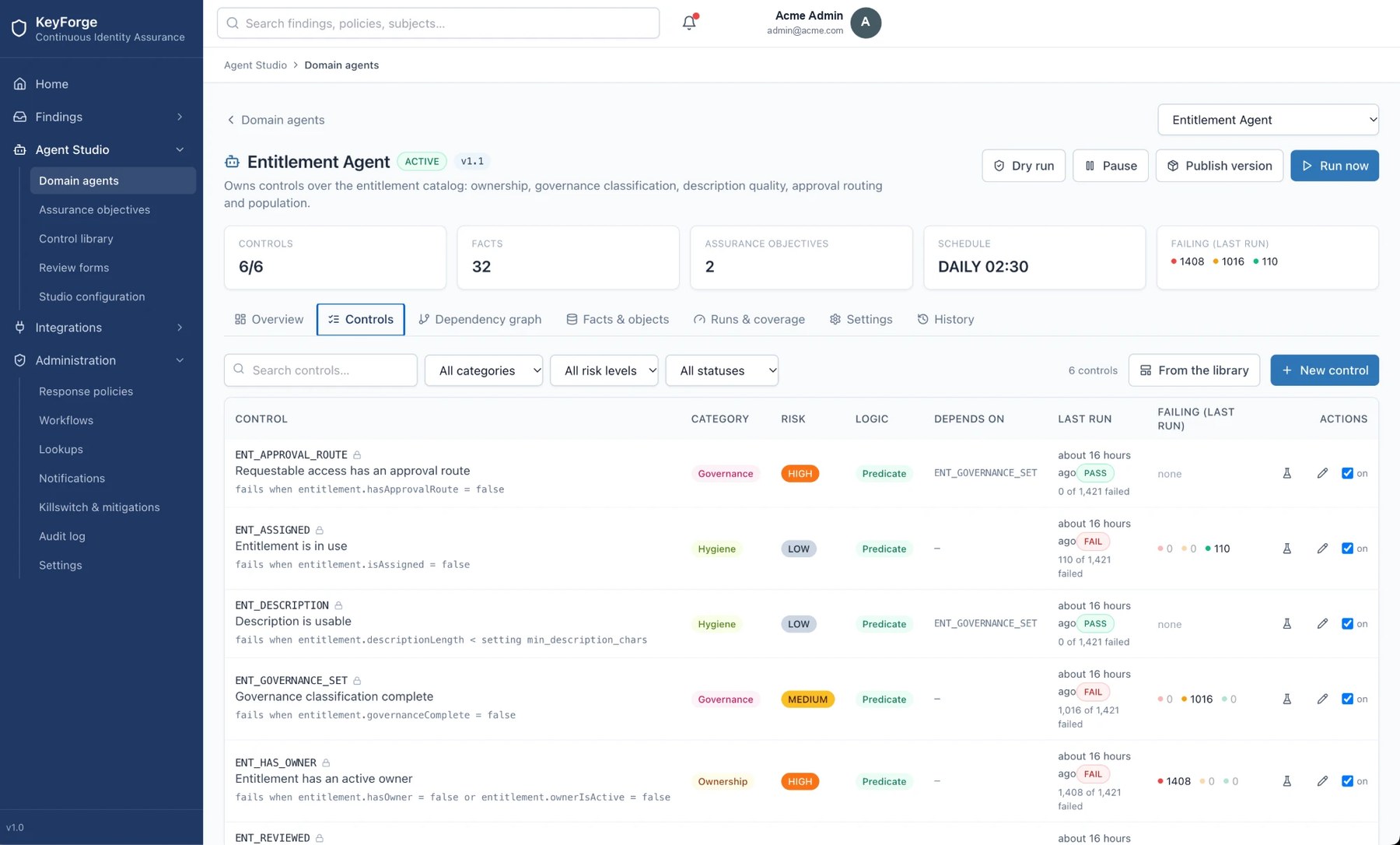
Every control is a readable predicate

A control states its own failure condition in plain terms, carries a category and a risk level, declares what it depends on, and reports the exact population that failed on the last run. Nothing about the outcome is opaque.

Controls for a domain agent, each showing its failure predicate, category, risk level, dependencies and last-run pass or fail counts
Controls — predicate, risk, dependencies and last-run result

Deployment

Standalone, or layered on what you own

KeyForge AI is a continuous identity governance and assurance platform that can operate standalone or extend existing IGA investments with policy-driven reasoning, risk intelligence and automated remediation. Both models use the same engine, rules and evidence trail.

Want this walked through with your architects?

Request an architecture briefing — a working session on tier configuration for your regulatory posture.